
Page Contents
- 1 Details: 2 Stainless Steel Additional Temperature Probes for Multi-Probe Smart Bluetooth Wireless Remote Digital Meat Thermometers: Sensor, Handle, Cable Resist up to 716°F / 380°C
- 2 Advantages
- 3 Notice
- 4 Buyer Guide meat thermometer
- 5 How to choose meat thermometer
- 6 How to maintain meat thermometer
- 7 Review Rechargeable Digital Meat Thermometer, Oven Safe Food Thermometer Dual Probes for Cooking, Al...
- 8 Review AmiTabHas Meat Thermometer for Cooking, Digital Instant Read Food Thermometer with Backlight ...
- 9 Review Instant Read Meat Thermometer, 8 Meats Modes and Timer Modes, Digital Color Touch Screen LCD ...
- 10 Review Wireless Meat Thermometer, Digital Grill Thermometer Stable Remote Range BBQ Thermometer with...
Details: 2 Stainless Steel Additional Temperature Probes for Multi-Probe Smart Bluetooth Wireless Remote Digital Meat Thermometers: Sensor, Handle, Cable Resist up to 716°F / 380°C
Brand: Blameless Cooking


Advantages
- Products can be returned
- Make sure this fits by entering your model number.
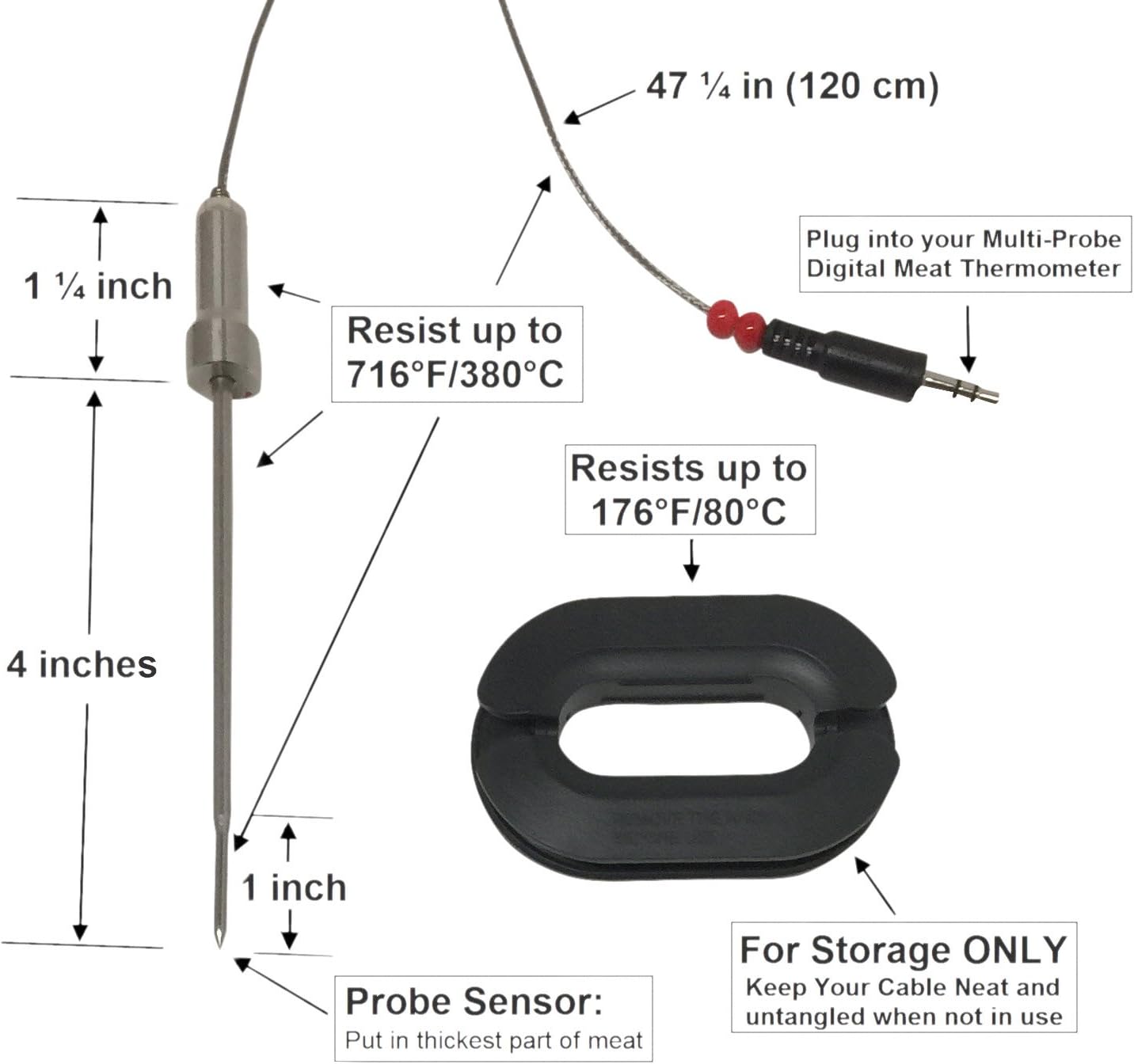
- USE AS ADDITIONAL PROBES for multi-probe Bluetooth Wireless Remote Meat Thermometers. Our Smart Digital Meat Thermometers can be purchased separately that can use up to 6 probes at one time. Just put your temperature probe in the meat, and the other end of the cable in the thermometer. Use the 2 colored beads to distinguish between other probes being used at the same time. The free APP will let you know when it’s done with an alarm. Then, ENJOY to your desired doneness.
- The MOST HIGH QUALITY STAINLESS STEEL PROBES available. The probe sensor, the stainless steel handle, and the 47-inch (120 cm) Teflon cable with stainless steel mesh ALL can resist a high temperature of 716°F/380°C. This is MUCH higher quality than the silicone handle on other probes that only resist up to 482°F/250°C
- The CONVENIENT STORAGE RACK provided with each probe gives an easy compact way to keep your cable untangled when not in use. However, this is only for storage purposes, and should not be used when cooking in the oven, for barbecue grilling or smoking, since it only resists up to 176°F/80°C.
- GIVE QUALITY CARE FOR YOUR PROBES: Probes can be washed by hand, but they are NOT dishwasher safe. Do NOT submerge your probes in water. Do NOT use your probes in a microwave oven. Keep open fire flames away from probes, as they could be hotter than 716°F/380°C.
Notice
- Is an online purchase
- Delivery may be delayed in some areas.

Buyer Guide meat thermometer
When buying a meat thermometer, there are a few things you should consider first.- Price. Price is the first thing you should consider. The more expensive the thermometer, the better it will be.
- Temperature Range. The temperature range of the thermometer will determine the kinds of meats you can cook.
- Accuracy. Accuracy is very important as well. The thermometer’s accuracy will determine how well it will cook the meat.
- Look. The thermometer’s look is also important.
How to choose meat thermometer
When shopping for a meat thermometer, there are a few factors to keep in mind:- What temperature are you looking to store? Meat thermometers store temperature in one of two ways: Fahrenheit or Celsius. Some options also store temperature in degrees Kelvin.
- What size are you looking for? Meat thermometers come in a wide range of sizes, ranging from 2 inches to 2 feet. The size you choose will largely depend on how much meat you need to cook, and your storage needs.
- How accurate is the thermometer? Accuracy varies widely between meat thermometers. Some higher-end units have features like colored lights that indicate different levels of doneness. Some higher-end options also store temperature in degrees Kelvin.
How to maintain meat thermometer
Maintaining your meat thermometer is easy. Always wash your hands after touching your meat thermometer and allow it to dry thoroughly before storing it. Always clean your meat thermometer before you store it. To do this, remove the needle and dunk it in a bowl full of hot water. After the needle is removed, clean the thermometer with a paper towel. If needed, use a toothpick to remove food particles from the needle before putting it back into the meat thermometer.
- Store your meat thermometer in a dry place away from direct sunlight. A dark cabinet or drawer is fine.
- Store your meat thermometer away from other items that are likely to spill on it.
- Never store your meat thermometer in a plastic bag.
- Never store your meat thermometer in a glass or metal container.
- Dont leave your meat thermometer on the countertop.
Related posts:
Review Rechargeable Digital Meat Thermometer, Oven Safe Food Thermometer Dual Probes for Cooking, Al...
Review AmiTabHas Meat Thermometer for Cooking, Digital Instant Read Food Thermometer with Backlight ...
Review Instant Read Meat Thermometer, 8 Meats Modes and Timer Modes, Digital Color Touch Screen LCD ...
Review Wireless Meat Thermometer, Digital Grill Thermometer Stable Remote Range BBQ Thermometer with...

FBIA TEAM
Admin Tle Chubby man who loves technology and the changes in the world around him. (Around Me)